Science, Technology, Engineering, Arts, and Math in everyday play.
STEAM vs STEM in early childhood is simpler than it sounds. STEM builds skills for exploring, building, and measuring; STEAM adds the Arts so young children can express ideas, notice patterns, and explain their thinking. At Little STEAMers in Skyway, that looks like drawing observations, building models, singing patterns, and telling short stories about what we made. When you’re ready, Enroll Now or Schedule a Tour.
Put simply, STEAM vs STEM in early childhood adds the Arts so kids can explain what they discover in science and math.
STEAM vs STEM in early childhood
- STEM: Science, Technology, Engineering, Math—experimenting, observing, testing, counting.
- STEAM: All of STEM plus the Arts—drawing, music, storytelling, and design—so kids can see, say, and show their ideas.
Why the “A” matters: Preschoolers think with their hands and voices. When they can sketch, sing a pattern, or explain a build, they stay engaged longer and retain more. Learn more on our STEAM page
What STEAM looks like in our day
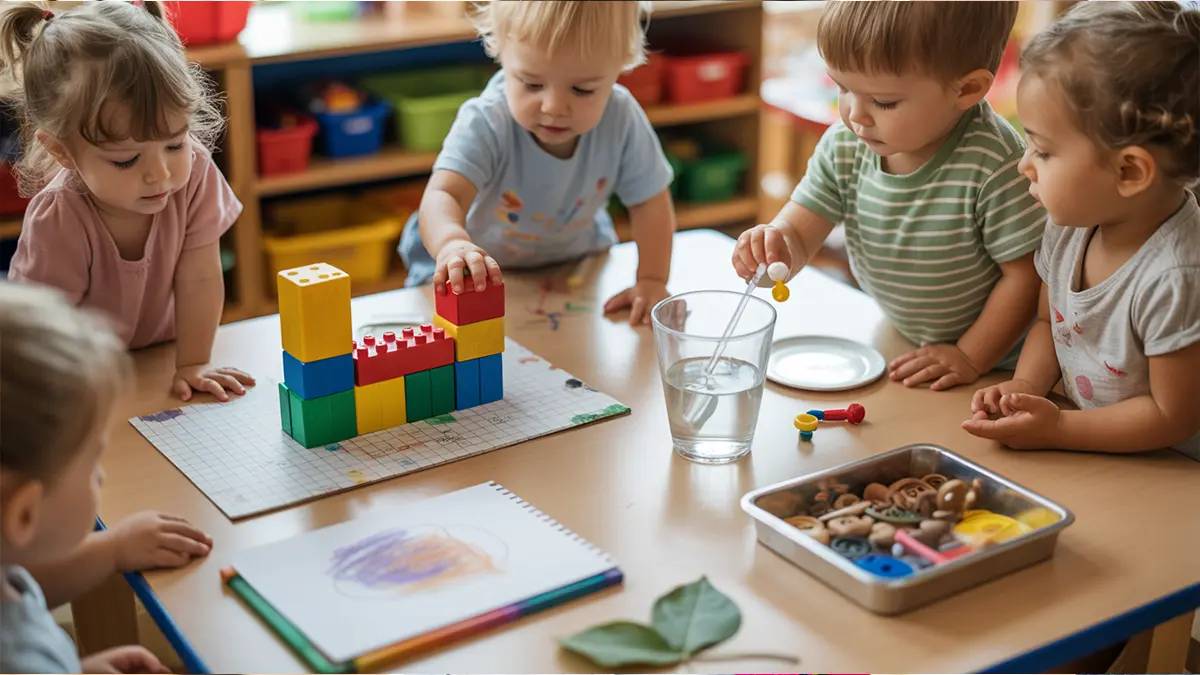
- Morning centers: Block towers with “pattern floors,” tracing shapes before counting sides.
- Snack chats: Predict how many slices we’ll have after sharing, then draw it.
- Outdoor time: Leaf sort → pattern collage → count and compare sizes.
- Nap wake-ups: Soft music patterns, then journal a picture of “one thing I wondered.”
- Afternoon projects: Build a bridge from recyclables and tell the story of what it can carry.
These tiny habits show how STEAM vs STEM in early childhood keeps curiosity high and frustration low.
Pro tip: Label feelings and findings: “You tried three shapes, then changed your plan. That’s engineering.”
How STEAM supports calmer days for families
For many families, comparing STEAM vs STEM in early childhood makes the value of the “A” obvious—calmer transitions and clearer language. When children can draw, sing, or act out what they built, they process feelings and ideas at the same time. That makes transitions easier—into the classroom, into nap, and back home at pickup. In practice, we blend quick arts cues into science and math: sketch the plan before stacking blocks, clap a pattern before counting steps, tell a one-line story about a bridge we made from recyclables.
These tiny additions keep attention longer and help kids explain what they discovered. Families notice the spillover at home: smoother dinner, earlier bedtime, more confident mornings. Have questions? Visit our Contact page. Want to see how we structure STEAM during the day? Explore Early Childhood STEAM Education.
5 mini prompts you can try tonight (3–5 minutes)
- Pattern clap: Clap 1–2–1; have your child echo, then invent a new one.
- Shape hunt: Find 3 circles in your kitchen; draw them fast.
- Story build: Stack books as a “stage,” act out a toy’s trip across the bridge.
- Count & compare: Line up socks by size; which row is longer?
- Sound graph: Tap a cup gently vs. firmly; draw two lines—quiet and loud.
1) Pattern Clap
Goal: Notice and copy patterns, then create one.
Time: 2–3 minutes
You’ll need: Just your hands.
Do this (step-by-step):
- Clap 1–2–1 (slow, steady).
- Say: “Your turn—copy my claps.”
- Repeat once. If they echo it, celebrate.
- Say: “Now make your own pattern. I’ll copy you.”
- Try a new pattern: 1–2–3–2–1 or 1–1–2–1–1.
Say it like this:
“Pattern means something that repeats. I’ll go first. 1–2–1. Your turn!”
Age tweaks:
- Toddlers: Keep it short (two patterns, tops). Use clap / lap tap.
- Preschoolers: Add a rule—“Only 5 claps total.” Or switch body sounds (clap, snap, stomp).
Try → Talk → Tweak note:
- Try: “Clapping patterns before bedtime.”
- Talk (to teacher): “They invented 1-1-2-1-1 easily.”
- Tweak: “Tomorrow we’ll try clap + stomp.”
2) Shape Hunt
Goal: Spot shapes in the real world and sketch quick “evidence.”
Time: 3–5 minutes
You’ll need: Pencil + scrap paper (or sticky notes).
Do this (step-by-step):
- Say: “Let’s find 3 circles in the kitchen.”
- Point to one (cup rim). Ask: “How do you know it’s a circle?”
- Brief sketch: draw a small circle and label it ‘cup’.
- Find two more circles (lid, plate), sketch and label.
- Count the sketches together: “We found 3 circles!”
Say it like this:
“Circle = round, no corners. What else is round in here?”
Age tweaks:
- Toddlers: Hunt 1 shape only; trace a lid with your help.
- Preschoolers: Add a second shape (triangle/square). Make a quick tally—how many of each?
Try → Talk → Tweak note:
- Try: “3 circles before snack.”
- Talk: “They named ‘no corners’ on their own.”
- Tweak: “Tomorrow we’ll add triangles.”
3) Story Build
Goal: Plan, build, and tell a beginning-middle-end story.
Time: 5 minutes
You’ll need: 3–5 books (for “banks”), a spoon or ruler (for “bridge”), 1 small toy.
Do this (step-by-step):
- Stack two short piles of books as “river banks.”
- Lay the spoon/ruler between piles to make a bridge.
- Ask: “Who needs to cross?” (pick the toy)
- Tell a 3-part story:
- Beginning: “The (toy) needs to cross.”
- Middle: “The bridge wobbles; we add support.” (slide another book closer)
- End: “Success! They wave from the other side.”
- Test: Can the bridge hold the toy? If it sags, adjust supports.
Say it like this:
“What does our bridge need so it doesn’t wobble?”
Age tweaks:
- Toddlers: You place the “bridge,” they move the toy across.
- Preschoolers: Measure span with blocks (how many long?). Try a heavier toy.
Try → Talk → Tweak note:
- Try: “One tiny bridge story after bath.”
- Talk: “They added a second support to stop wobble.”
- Tweak: “Tomorrow we’ll measure the span in blocks.”
4) Count & Compare
Goal: Compare lengths/quantities using everyday language.
Time: 3 minutes
You’ll need: 6–10 socks.
Do this (step-by-step):
- Make two lines of socks on the floor. To compare length, touch toes to the same line.
- Ask: “Which line is longer? Which is shorter?”
- Count socks in each line: “Which has more? Which has fewer?”
- Swap one sock from the long line to the short line—ask again.
Say it like this:
“Line them up toe-to-toe so we can compare.”
Age tweaks:
- Toddlers: Just match pairs (same color/pattern) and say “same.”
- Preschoolers: Use a tape measure or blocks—“How many blocks long?”
Try → Talk → Tweak note:
- Try: “Count & compare during laundry.”
- Talk: “They used ‘more/fewer’ correctly.”
- Tweak: “Tomorrow we’ll measure with blocks.”
5) Sound Graph
Goal: Connect sound strength to a simple “graph line.”
Time: 3 minutes
You’ll need: Paper + pencil, a wooden spoon (or pencil) and an empty cup.
Do this (step-by-step):
- Tap the cup gently. Draw a short line on paper. Say: “quiet.”
- Tap firmly. Draw a tall line. Say: “loud.”
- Alternate quiet/loud taps while your child draws short/tall lines to match.
- Ask: “Can you make medium? Show me the middle-size line.”
Say it like this:
“We’re drawing the sound we hear.”
Age tweaks:
- Toddlers: Only quiet vs loud; you draw, they point.
- Preschoolers: Do three volumes (quiet/medium/loud) and then echo a rhythm (short-short-tall).
Try → Talk → Tweak note:
- Try: “Sound graph before bedtime story.”
- Talk: “They matched loud/quiet lines on their own.”
- Tweak: “Tomorrow we’ll add ‘medium.’”
Quick parent cheat codes
- Keep it short and stop while it’s still fun.
- Name the process, not the product: “You tested and changed your plan.”
- Snap a photo and share one sentence with the teacher—those notes help them personalize tomorrow’s activities.
Have questions? Visit our Contact page. Want to see how we structure STEAM during the day? Explore Early Childhood STEAM Education.
Try → Talk → Tweak (in action)
- Try: One mini prompt each evening before bath.
- Talk: Tell your teacher one thing that lit your child up.
- Tweak: Shorten, swap materials, or move the prompt to morning if energy is better then.
Small, shared adjustments make school-to-home learning feel seamless.
Downloadable: STEAM vs. STEM Quick-Start Kit (Free)
Make it easy to start tonight. Print this one-page guide with kid-friendly definitions, five mini prompts, Try → Talk → Tweak, and parent pro tips. This STEAM vs STEM in early childhood quick-start kit makes it easy to try tonight.x
What it is: A printable, one-page STEAM vs STEM in early childhood quick-start kit for busy families.
What’s inside:
- Kid-friendly definitions of STEM and STEAM
- Five 3–5-minute prompts you can try tonight
- Try → Talk → Tweak daily loop for seamless school-to-home learning
- Weekly micro-habit checklist to celebrate small wins Who it’s for: Parents and caregivers who want calmer routines and stronger language around science and math in Skyway. How to use: Print, post on your fridge, and share a quick note with your teacher about what lit your child up.
FAQ
Is STEAM too advanced for toddlers?
Not at all. STEAM at this age looks like sorting, building, singing patterns, and drawing observations—short, playful, and hands-on.
Will STEAM still cover core math and science?
Yes. The Arts help children notice, name, and explain what they discover in science and math, so learning sticks.
How can I try STEAM at home in five minutes?
Clap a pattern to echo, sketch three circles you find in the kitchen, or build a tiny bridge from spoons and tell a one-line story about it.
Why does the “A” help in early childhood?
Because children think with their hands and voices. Adding the Arts turns trying into explaining, which makes learning stick.
The Big Picture
When families compare STEAM vs STEM in early childhood, the “A” consistently improves attention, language, and confidence. STEAM isn’t “more to do”—it’s a smarter way to learn. The Arts help children notice, name, and explain what they discover in science and math. That builds curiosity, focus, and the confidence to try again tomorrow.
This article is educational only and not medical advice. For concerns or emergencies, contact your pediatrician or call 911.