How Our Monthly Themes Work
Our STEAM Lab monthly themes give children a simple, steady way to explore science, technology, engineering, art, and math in Skyway. Each month we rotate open-ended materials, pose juicy questions, and keep development and safety front and center—so curiosity grows alongside confidence.
STEAM Lab Monthly Themes at a Glance
January — Ice, Water, Wind
- Melting races, pipettes, wind tunnels with scarves.
- Science practices: observe, predict, record.
- At-home idea: “Will it melt faster in my hand or warm water?”
February — Tinker Shop
- Real-world tools (school-safe), screwdrivers with boards, take-apart center.
- Fine-motor strength; persistence through “try again.”
- At-home idea: Old remote (batteries removed) + tiny screwdrivers under supervision.
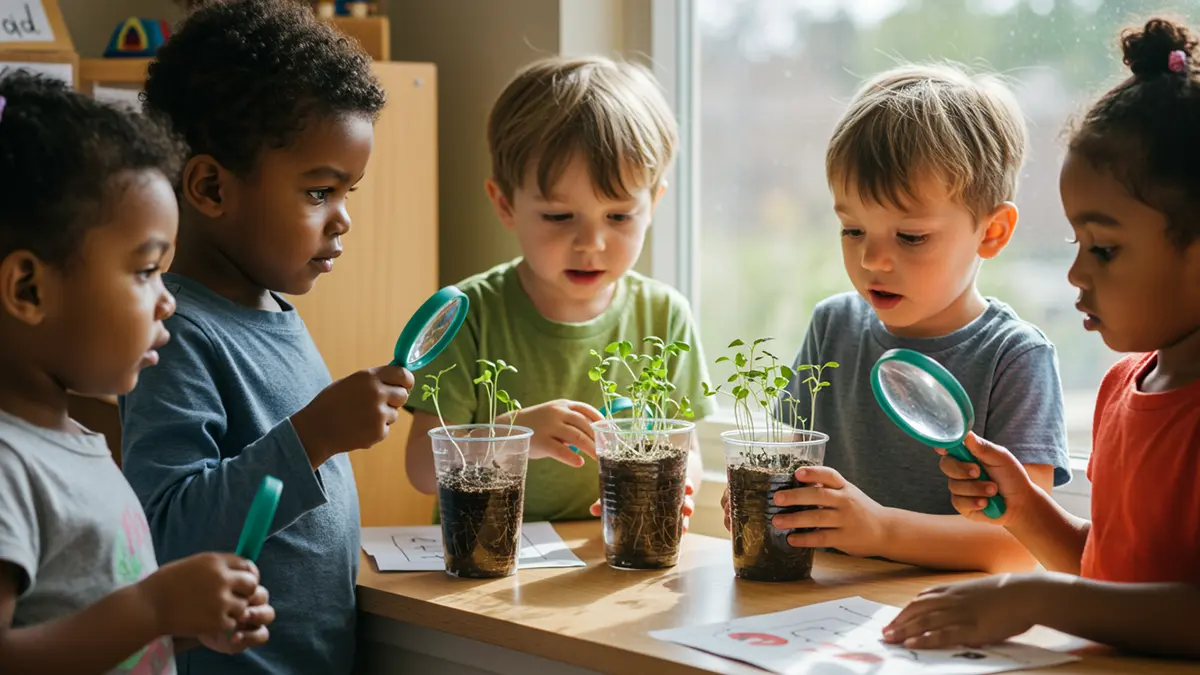
March — Sprouts & Soil
- Seed jars, root viewers, class garden charting.
- Measuring growth; living/non-living classification.
- At-home idea: Sprout beans in a baggie on the window—draw what you see.
April — Things That Roll
- Wheels vs. spheres, friction tests with different surfaces.
- Design loop: design → test → tweak → retest.
- At-home idea: Tape two different “roads” (tile vs. rug) and time your toy car.
May — Color & Mix
- Color walks, mixing stations, coffee-filter tie-dye.
- Language: hue/shade; sequencing steps.
- At-home idea: “What new colors can we make with only red, yellow, blue?”
June — Floating & Sinking
- Buoyancy bins, boat-building challenge.
- Early engineering: stability, weight distribution.
- At-home idea: Build a foil boat—how many pennies can it hold?
July — Magnets & Motion
- Magnet trails, “what sticks?” surveys, race with magnetic wands.
- Sorting & data: yes/no charts; new vocabulary.
- At-home idea: Magnet scavenger hunt (avoid button batteries; see safety note).
August — Nature Labs
- Leaf presses, “tiny worlds” with loose parts, simple classification keys.
- Scientific drawings; respect for living things.
- At-home idea: Build a “nature museum” shelf with labels your child dictates.
September — Build & Balance
- Ramps, blocks, and “will it tip?” experiments.
- Early math: comparing heights/lengths; language for cause/effect.
- At-home idea: Stack pantry boxes; predict which tower needs a wider base.
October — Light & Shadows
- Flashlights, translucent blocks, shadow puppets.
- Vocabulary: transparent/opaque/translucent; noticing shapes.
- At-home idea: Shadow hunt at dusk—trace with sidewalk chalk.
November — Sound & Rhythm
- DIY instruments, clapping patterns, quiet/loud investigations.
- Early literacy: syllable claps; math: AB/ABC patterns.
- At-home idea: Kitchen-band parade; sort objects by the sound they make.
December — Kindness & Community Engineering
- Build mail “systems,” delivery routes, and helper tools.
- Executive function: planning steps; social-emotional language.
- At-home idea: Design a thank-you card station; count how many deliveries you make.
What This Looks Like by Age
Infants (Wanderers)
- Sensory trays (chill/warm, rough/smooth) to build body awareness.
- Short, face-to-face exploration with narration to grow language.
Toddlers (Roamers)
- Ramps, scoops, and pouring—early problem-solving and control.
- Visual supports and tiny choices to practice independence.
Preschool & Early Pre-K (Travelers, Explorers)
- Multi-step tinkering projects with simple planning (“first/then/last”).
- Comparing, measuring, and explaining ideas to peers.
Older Pre-K (Investigators)
- Design challenges with constraints (“must float and carry 10 marbles”).
- Documenting results with drawings, labels, and kid-friendly graphs.
Curious what this looks like in each age group? Explore our Programs or Schedule a Tour to visit a classroom in person.
Safety by Design
We plan for safety the same way we plan for learning — in the routine. Teachers preview how to use materials, set clear boundaries (“water stays at the table”), and keep supervision within arm’s reach for water, tools, and outdoor play. Consistent habits make safety second nature for children and adults alike.
- Daily room scan and small-parts “tube test” when setting up materials
- Clearly labeled shelves; choking hazards and magnets stored out of reach
- “Mouthed items” bin and frequent sanitizing of high-touch materials
- Allergy-aware snacks and posted care plans; medications locked, EpiPens accessible to trained staff
- Playground walk and gate/door checks before outdoor time; radios carried outdoors
- All staff certified in Pediatric First Aid/CPR; regular fire/earthquake/lockdown drills
Safety Check: Magnets and button batteries are never used as loose parts. Water play stays at the table with a grown-up within arm’s reach. For concerns or emergencies, call your pediatrician or 911.
Families & Classrooms: Grow Together
Use our STEAM Lab Sprout Journal to keep home and school in sync—pick the Original page for preschool/pre-K writers or the Toddler page with simple check-marks. Print one page per plant, spend 2–3 minutes a day noticing, sketching, and measuring, then use the Try → Talk → Tweak prompts to grow shared language and persistence. Keep the sheet by your sunny spot, add a quick Mini Log each day, and send a photo (or the page itself) back and forth so families and teachers can celebrate growth together. Safety tip: a grown-up stays nearby for watering; no small loose parts for under-3.
- STEAM Lab Sprout Journal (PDF) — a 1-page, print-friendly log to help kids notice, draw, measure, and talk about seedlings each day.
Try This at Home Tonight (10 Minutes): Ramp Remix
You’ll need: a cookie sheet, a book to prop it, two toy cars, masking tape.
- Tape a “start” and “finish.”
- Roll two cars—what happens if we change the angle?
- Add language: faster, slower, farther, steeper.
- Two-minute tidy with a high-five.
What You’ll Notice in the First Two Weeks of a Theme
As a new STEAM Lab theme begins, you’ll hear fresh language and see small routines that make big thinkers: noticing (“I see two leaves!”), comparing (“This one is taller.”), and testing (“What happens if we move it toward the light?”). Children settle into predictable steps—gather tools, try it safely, talk about what changed, then tweak and try again.
- New words in everyday talk: sprout, measure, compare, predict, design.
- Short “See → Try → Talk → Tweak → Show” loops modeled aloud so kids learn how to test ideas safely.
- Documentation grows: sketches, simple tallies, and “before/after” photos or drawings.
- Confidence lifts: kids choose tools, share ideas, and celebrate small wins (“It grew!”).
Curious how this looks by age group? Explore our Programs or Schedule a Tour to visit a classroom in person.
The Big Picture
Our monthly STEAM Lab themes aren’t crafts on repeat—they’re invitations to notice, test, talk, and try again. Over the year, children build core habits of scientists and engineers: curiosity, problem-solving, persistence, and collaboration. We keep safety and child development front and center, and we spiral skills a little bigger each month so learning sticks.
This article is educational only and not medical advice. For concerns or emergencies, contact your pediatrician or call 911.